11th October 2026
To ASSUME makes an ASS of U and ME...
The response to last week's Thought (and thank you to all who read it!) demonstrated that I made certain assumptions with regards to language and communication that I should not have made. I assumed that the acronym GMH was familiar, and failed to explain it as Global Majority Heritage. I suspect I left more people mystified than those who contacted me. When Zara Rawlinson, the Diocesan Racial Justice Officer spoke to the Deanery Synod on Monday night, she used the acronym UKMEGMH - UK Minority Ethnic, Global Majority Heritage. It reflects the fact that, globally, white European ethnicities make up only 10-15% of the world's population. Linguistically, it is more accurate to speak of global majority heritage than to use language that consigns people to a minority. And language matters, because language reflects our assumptions.
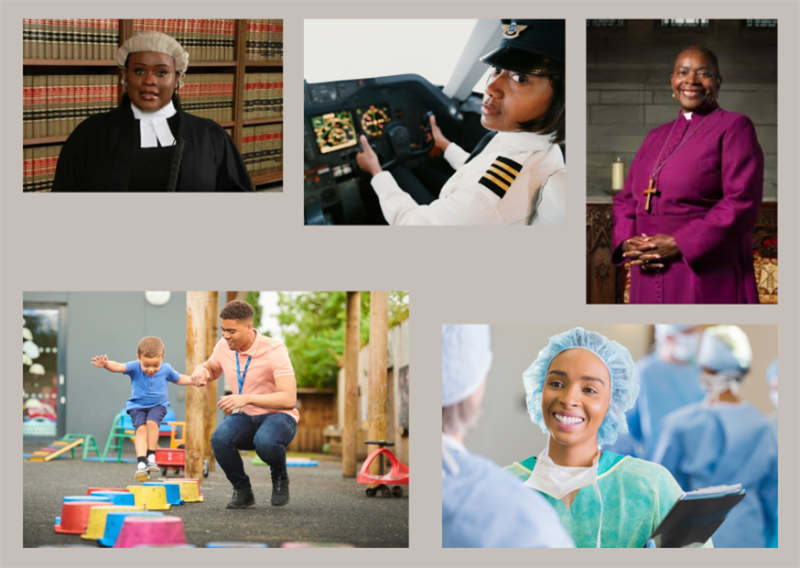
Assumptions are not bad in themselves. Indeed, we can only function in the world by assuming certain things. If I question everything all the time, I will soon be overwhelmed and unable to function. But assumptions leave us with certain expectations or unconscious biases. I wonder if the pictures above surprised you? Perhaps they challenged certain unconscious assumptions we make regarding jobs and gender.
In Black History Month, we are confronted with the task of acknowledging that white assumptions of how the world should be were exported across the globe by colonialist ideologies, and that these assumptions have caused real injustice and harms. History, in African countries and in India for example, did not begin with the British or any other European Empire: those cultures were already vibrant and flourishing at a time when, as a friend of mine put it recently, we were still running around painted blue.
I've been reading John's gospel and, in John 9, following Jesus' healing of a man born blind, John plays with imagery of blindness and sight in reflecting on how that healing challenged the assumptions of the religious leaders as to how the world should work. Blindness, they assumed (as we see with the disciples' question to Jesus in verse 1), was the result of sin. In making mud and healing on the Sabbath, Jesus had broken one of the most important religious laws of the community. And yet, before the astonished eyes of these leaders is the incontrovertible evidence of a man healed. What should they think? Should they trust their assumptions of how things should be? Or should new evidence lead them to ponder that perhaps they need to revisit their assumptions? In the last verse of the chapter, verse 41, Jesus gives his verdict: "If you were blind, you would not have sin. But now that you say, "We see," your sin remains."
I see that as an invitation to examine the assumptions I carry. With regard to the language I use - if I am offending someone by what I say, why? What is it that is hurtful? And could I, by seeing differently, find a way to express myself that doesn't cause pain? With regard to my expectations - who am I not seeing? Or who is Jesus inviting me to see differently? We all have areas of blindness, and being blind, as Jesus affirms, is not a sin. But, here, Jesus offers me the opportunity to see again and to see differently - and the warning that to cling obstinately to my blindness will lead to sin.
Language reflects our assumptions. If my use of language in this column has been clumsy or caused offence, I can only apologise. And request that, if I have offended you, you point out to me what is wrong, and tell me how I could have expressed it better.
08/10/2026