5th July 2026
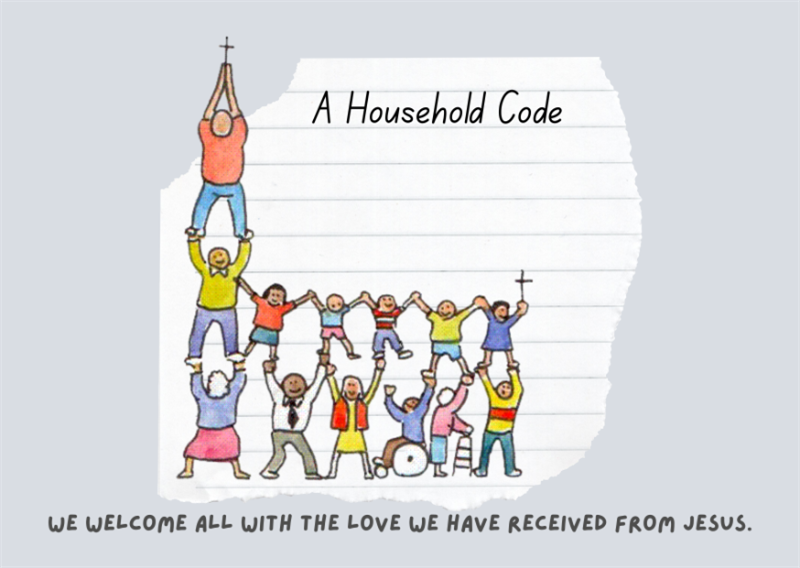
All are welcome... aren't they? (4)
The Household Code
If we've been at the 10.30am services over the past few weeks, we've been unpacking the incredibly challenging teachings of Jesus in the Sermon on the Mount. We'll be continuing to explore the Sermon on the Mount throughout the summer, so there's plenty more challenge to come!
A few weeks ago, I reflected in this column on us humans being at once saints, sufferers and sinners. Part of the reason Jesus' teachings in the Sermon on the Mount are so difficult is because they are a call to us to live out our relationships with one another as saints whose citizenship is in the new creation. In the new creation, all the things that make relationships so tricky will be healed; we will relate to one another in love in the same way as the persons of the Trinity relate to one another in love. But, for now, our relationships are damaged by hurt - we are sufferers - and by our own moral failings - we are sinners. And, of course, they are complicated by the hurts and sin of the people with whom we are relating.
And so, alongside the call to live as saints, to "be perfect (which could equally be translated as complete or mature) as your Father in heaven is perfect" (Matthew 5:48), the Bible provides various codes to help us work out what that looks like in practice. In the Old Testament, the moral truths in the Ten Commandments are worked out in the details of the law - many of which come down to relationships - caring for the vulnerable in the community - the foreigner, the orphan, the widow - not moving boundary stones for one's own advantage, how to resolve disputes etc. In the New Testament, towards the end of many of the letters, we find "household codes" - how the different members of the new community of the church should relate to each other.
To modern eyes, these codes are in themselves challenging. Because they take for granted the social structures and norms of first century society, they often speak of people within that society - women, for example, or slaves - in ways that we find difficult, even offensive. In Ephesians 5-6, for example, wives are told "be subject to your husbands, as to the Lord" (5:22) and slaves are told "obey your earthly masters with fear and trembling" (6:5). These verses have been taken out of context over the years, misused and abused by those in power to keep others in their place. In fact, the astonishing thing in these verses is not that wives are commanded to submit and slaves to obey - this would be culturally completely normal. The extraordinary, and hugely countercultural instructions are those to the powerful. "Husbands, love your wives, just as Christ loved the church" (5:25); "And masters, do the same (looking back, that's "render service") to your slaves; stop threatening them..." (6:9).
In the church, therefore, the call is, as we saw last week to "submit to one another out of reverence to Christ" (Ephesians 5:2). But the challenge is greater the more power a person has. So perhaps, for us, the question is: who holds the power here at HTSJ? How are we choosing to use that power within our relationships? And how might we who are powerful choose to give away that power, "out of reverence to Christ"?
02/07/2026